
Installment Four
Buffalo wallows
Going up the road past the windmill at Grandpa’s place to the pastures on top of the hill were two buffalo wallows.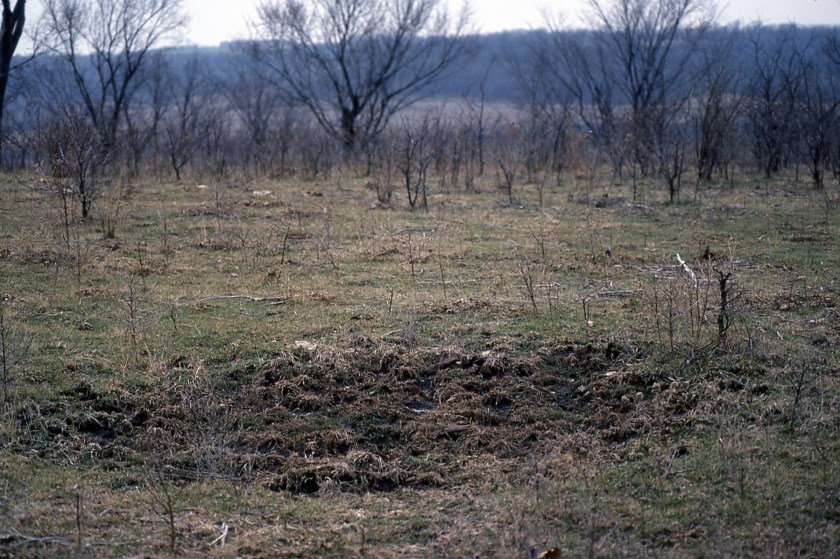 These are depressions in the ground where water accumulated. They are typically found on the prairies but these two were on a plateau half way up the hill in an area that was near a natural year-round spring. The buffaloes wallowing abraded hair, oils and cellular debris that kept the wallows from draining, which prolonged the available water. It also ‘killed’ the area so plants would not grow or were severely stunted if they did grow. The two on the hill rarely had anything growing in them.
The water moccasin
aka cottonmouth or Agkistrodon piscivorus is the only poisonous water snake in Kansas and the world’s only semi-aquatic viper. They will stand their ground when threatened and open their mouth to display their fangs and the white lining of their mouth. I found one below the barn at Grandpa’s where the road dipped to cross the creek to go to the big field. Instead of a bridge to cross the crick, the bank was cut down on both sides, the crick was probably eight to ten feet deep, and there were two eighteen inch tubes about ten feet long for the water to flow thru. The road was built over them. There were always piles of sticks that had washed down from trees overhanging the crick, collecting around the tubes. I was eight or ten and was looking for arrowheads and crawdads one day and here was this cottonmouth hissing at me with his mouth agape atop one of these piles of sticks.
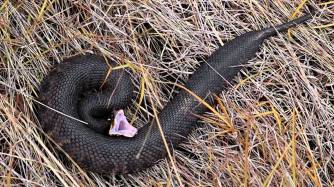
I knew instantly what it was, just like one knows a rattle snake rattle the first time it is heard. I ran back to the barn to get Dad or Grandpa and a gun. It was probably four or five hundred yards, or maybe a mile – it was a looong way, to the barn and I was setting a world record! Dad and I jumped in the truck and sped to the crossing but the snake was nowhere to be found. We carefully poked around a bit but couldn’t find it. I was always leery of snakes after that!
Snapping turtles
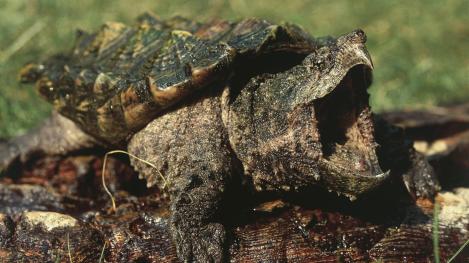
Nasty creatures!
They could ruin a pond dam by burrowing into it. We always had at least one and usually two rifles in the truck for varmints like cottonmouths, rattlers, copperheads, coyotes, and snapping turtles. The driveway to Grandpa’s place was east of the Wellman Road, which was east of Mud Crick. There was a pond here that always seemed to attract snapping turtles from Mud Crick. We were constantly pulling over to shoot them. No swimming in this pond! This pond will be part of another story.
Frog gigging
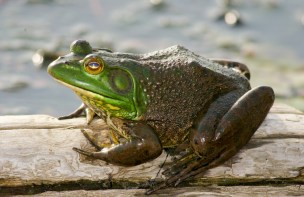 The bull frogs would be croaking to attract mates and that was the time to get ready to go giggin’. It could be done on foot but was more difficult, you always got muddy, and snakes are difficult to see in the dark. Frog giggin’ was always done in the dark on a pond, crick or slough (pronounced ‘slew’) in a boat. You would paddle slowly and quietly around listening for the deepest sounding croaker. A flashlight was used to locate and ‘freeze’ the frogs in the shallows on the banks. Shine the light in their eyes and they would hold stone still. The trick was to get within eight feet or so to be able to reach them with the gig.
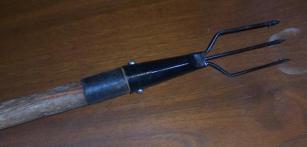
We would come home with hundreds of frogs. Well maybe not hundreds but at least forty to fifty – takes lots of frog legs to make a meal. Those not already dead had to be dispatched, skinned, cleaned and the legs detached. Before frying them you had to remove a nerve to keep the legs from jumping out of the frying pan. Frog legs are delicious!
Columbine Lodge
My cousin Ren was a year younger than me and we were partners in crime. Ren and his dad, Uncle Bill, who was actually a great uncle and was built like a bull, frequently accompanied us frog giggin’. Ren and I had lots of sleepovers and one night we stayed up late to watch wrestling on TV. Our favorite wrestler was Dick The Bruiser. 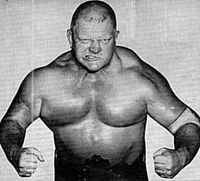 He was this huge guy that was a great wrestler. Uncle Bill and Aunt Martha came home, a bit tipsy, from a party while we were watching wrestling. Uncle Bill tells us to get him in any wrestling hold we wanted; we were maybe ten, After huddling to plan our hold, we had him lay down on his back with his arms straight out from his sides, palms up. With his size we figured this would be his most vulnerable position. Then we each sat on a hand. He asked if we were ready and without waiting for a response lifted us up, arms straight, and slammed us together over his chest.
One summer they asked me to go with them to their cabin in Green Mountain Falls, Colorado, for a month. Ren and I shared the only room in the ‘basement.’ It had one large sliding glass window. We were sneaking out one night and I was opening the window. My hand slipped and my elbow went thru the window. It bled like a stuck pig! We put a couple of band aids on it and called it good. I still have the scar. The cabin was not far from the Columbine Lodge and of course Uncle Bill knew the owners. 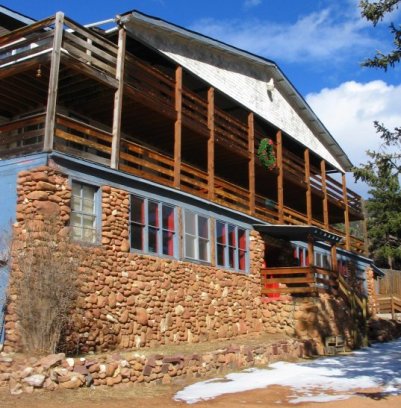
They were remodeling the lodge that summer so there were no guests. Ren and I would go over and help out for two to three hours a day then go off exploring. There was a crick flowing thru the town so we decided to follow it to see where it went. It was about two feet across and maybe a foot deep, crystal clear, cold, and delicious. The grass-covered banks snaked back and forth thru a lush green valley with aspen, pines and mountains all around. We found a beaver dam, a second, and a third and kept going. It started going uphill and we continued, finally coming to a gravel road. Great view! What else would one do but keep going up! Along comes a truck. It stops. This ranger gets out and sternly asks who we are and what are we doing on this road. We explain about the crick, beaver dams, valleys and then finding this road. Turns out we were on the road to Pikes Peak. He was not happy but did give us a ride back down to Green Mountain Falls.
Ren had two older sisters, Martha Jo and Jeanie. Jeanie, the younger daughter, married a local rancher, Curtis Stewart, who was about twelve years older. Uncle Bill was furious! Curtis had this huge tree on the side of a hill that he hung a rope from. The rope was probably fifty feet long with a wooden contraption you sat in. You held onto a rope that he used to pull you up the opposite hill on his horse, then you let go and swung in this HUGE arc from hill to hill.
We had a Shultz Christmas party every year two weeks before Christmas. The kids made a haul while the adults drew names to exchange gifts. At these, or any family gatherings, Uncle Bill would not be in the same room with Curtis. He would eat at the kids table and after dinner would be in the kitchen with the women. Jeannie should have listened to her Dad! She went missing and Curtis claimed she ran away. She was later found at the bottom of a well that Curtis had bulldozed closed. He was convicted and died about fifty years later in prison. Uncle Bill and Aunt Martha did not live to see justice. They were in a plane crash in Germany. Aunt Martha died in the crash and Uncle Bill a short time later from infected burns.
Stanley Sheppard
Was an amazing man! He was Black, or at that time, Negro. He had polio as a child and his right leg was shorter and had little muscle. I could out run him but had hell to pay when he would catch me unawares later. I admired Stanley Sheppard. He was funny, strong as an ox, gentle and kind. And he rolled his own cigarettes, one handed! He would pull his papers out of his shirt pocket, remove one and replace them in the pocket. Then out came the little bag of Bull Durham tobacco with the red string tie. 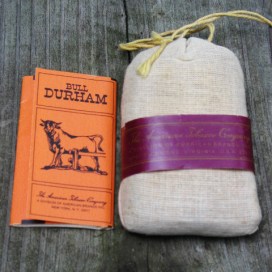
Open the bag, pour some tobacco out in the paper, pull the red strings with fingers and mouth to close the bag, and while putting the bag in his pocket with one hand was rolling the cigarette with the other. He always carried wooden stick matches that he struck with his thumb. He would hold it in his fingers with just the head of the match sticking up, then flick the head with his thumb nail, like you were shooting a marble, and not burn his fingers! The whole process from paper to fire was a smooth, fluid motion and pure magic.
Stanley was a part time hired hand that Dad called when hay needed to be bailed or crops harvested. I wish I knew the story about how they became friends. This was in the late Fifties and early Sixties when racial tensions were bad. We had been bailing hay and stopped for lunch, which in itself was unusual because we rarely stopped when bailing hay. The saying, ‘make hay while the sun shines’ was so true. Too early in the day and the alfalfa was too wet. Too late and the dew would make it too wet. Wet hay, packed tightly in a barn, would heat up and spontaneously combust, burning down barns and making winter cattle feeding costly. Anyway, Stanley, his Uncle, our full-time hired hand, Chuck, Dad and I went to the red house which was just across Mud Crick from where we were working. As we washed up at the hose and headed into the house to eat, Stanley’s Uncle, whose name I cannot remember, stopped and said he would eat outside on the steps. My Dad stopped, caught him by the arm and said, “Like hell you will! You’re coming in to eat at the table with the rest of us!” That made a HUGE impression on me but I think Stanley’s Uncle was dumbfounded. He seemed, at first, to be offended, as if to say get your hands off of me, then when Dad slapped an arm around his shoulders to guide him inside it was like a huge weight had been lifted from his shoulder. I’ll never forget the look on his face. Some say Dad was a redneck, and maybe he was, but he was friends with the Sheppard’s and many other blacks.
Power Wagon
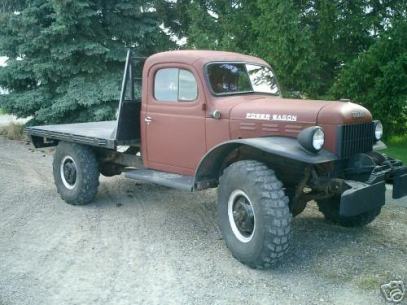
Dad got a Dodge Power Wagon to use to feed the cattle in the wintertime. It had more clearance and shorter wheelbase than the International pickup we had. Early one spring morning, as things were beginning to thaw out, we were headed up the road past the windmill to feed the cattle on the top pasture. Feeding the cattle was done by standing in the back of the truck, on a pile of hay (alfalfa) bales, in the freezing wind, while Dad drives in a toasty warm cab. You cut the strings on the bale then dropped flakes of hay every ten feet or so. Dad would roll the window down and yell, “Boooooss. Here Booooss (drag out boss).” And the cows would come running. Literally. It was a sight to behold, while freezing your butt off. One time Dad hawked a lunger out the window, it hit the fence and froze before it could drip off. Cold. This particular morning we did not make it to the top pasture. We had gotten past one buffalo wallow and the bottom fell out of the road. The ground had thawed more here than the rest of the road. The Power Wagon was high centered. Meaning it was past axel deep and resting on the frame. The wheels just spun uselessly. So guess who gets to slog back to the barn to get a tractor? Yea, me. I got the 730 John Deere which was the biggest we had at the time. That was an exercise in futility. So I went back, on the 730, to get Chuck and the 620 John Deere, which was “my” tractor. Another exercise in futility. We finally got a neighbor to bring his bulldozer over and with both tractors and the dozer we were able to drag the Power Wagon to solid ground.
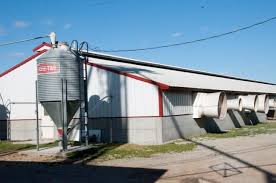
Dad decided to start raising hogs, so he built a pig barn similar to this – but ours did not have the exhaust fans:
Phew did it stink!
He converted the Power Wagon from a dump bed to a feed bed with auger, like this:
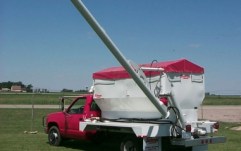
Dad knew everyone in Douglas and Jefferson counties. One of the guys he knew was a welder who was happy to swap his labor to remove the dump bed and install the feed bed for the dump bed. This was integral to the success of the Pig Palace (Dad’s name for the pig barn).
After completing the PP we started going to farm sales and auctions to buy piglets. We bought a LOT of piglets! A trip to a sale would net us anywhere from 10 to 100 pigs. Then we would sort them by size in the PP pens. The piglets weighed about ten pounds and we shipped them at about two hundred pounds. At its peak we were shipping a semi load of hogs, fifty or more, to market about every three to four weeks.
This is a drawing of the PP.  There were ten pens each ten feet wide by twenty feet long. There was an additional ten feet of slats over the lagoon which was an open sewage pit. The wavy lines depict the smell wafting up from the pig shit. The slats were rough cut oak which means that they were a full 2” wide by 4” high with square edges and rough on all four sides. Lumber yard 2×4’s are 1.5” x 3.5” with smooth sides and rounded edges. These native Oak boards were splinter factories, and HARD. We had to drill holes completely thru the boards to be able to drive the nails. The slats were cut with a bevel on each side and installed with the narrow side down and about ½” apart to facilitate the dropping of the droppings to the lagoon. In order to get the droppings to the slats – stoopid pigs crapped everywhere, not just on the slats – we had to scrape the crap from the cement to the slats.
  Farming is all fun and games! So every day, scrape and hose pig shit and make sure every feeder was full and every feeder and waterer was not clogged up, remove any dead hogs and try not to get crap on your pants,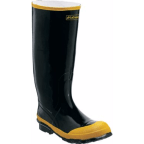
and this was before going to work. Pigs are omnivores and will eat their dead. Gross. Fortunately, not that many died. The smell was actually not that bad after the lagoon started ‘working’, ie; breaking down the crap and this chemical reaction helped to stem the smell – mostly. The feeders were on an auger system that was connected to a feed bin outside that was filled by the Power Wagon feed bed. So the feeding was mostly automated and only needed to be filled about twice a week.
International in the snow
With the conversion of the Power Wagon from carrying hay bales to sporting a fancy feed/auger bed we were back to using the International for feeding the cows.
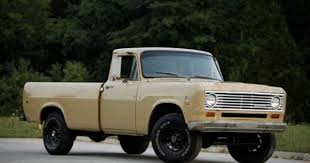
We had about a hundred head of cows and Dad claimed that he counted them every day by counting their legs and dividing by four. That was before I knew what Dad jokes were. He did know which calf belonged to which cow though. One day Dad and Chuck were feeding the cows, don’t know how I got out of it that morning, and after Chuck got all the hay off the truck they started out across the hilltop pasture in the routine of looking for strays and anything else that may be amiss. I SO wish I had been there this day! They were slowly going across the pasture when Chuck, in the bed holding onto the rain gutter of the cab, spotted a coyote. He told Dad, who stopped to pass one of the rifles to Chuck then took off hell bent for leather, which translated means going very fast without regard for safety, after the coyote. Chuck was leaning across the top of the cab, bouncing and pounding his elbows on the cab, when Dad hit a tree stump that was covered by snow and was consequently invisible. The truck comes to an abrupt stop, Chuck goes flying over the cab and lands in the snow about ten feet in front of the truck. Dad wisely did not start laughing until Chuck got up laughing. It took them a while to find the rifle because it plowed under the snow from the spot where it hit the snow. Coyote escapes. Probably laughing his ass off at the sight. The International was a great truck but on that day a flaw was discovered. The tie rod that connects both front wheels, so they turn equally, was installed in front of the axel. When they hit the stump the tie rod bent and turned both wheels in which made the truck un-driveable. Dad and Chuck had to slog about ¾ of a mile back to the barn, thru knee deep snow, to get a tractor. Sometimes farming is fun and games! How I wish I had seen that!
Tool box
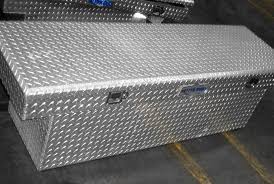 We built a wooden tool box for the bed of the International. It was the width of the bed and about two feet deep. There was a shelf running the width of the tool box that was divided into compartments to hold small tools, sockets, nuts and bolts, and other small stuff. The bottom held the 36” pipe wrenches, 36” long by 1”drive socket breaker bar, chains, shovel, ‘small’ portable tool box that probably weighed fifty pounds, and other assorted large tools. The top was slanted and covered in corrugated tin and hinged at the back. We had everything needed to complete most any repair or break down in the fields short of a total engine overhaul which was done in a clean barn. Right, clean barn. Dad would tell me to get a ½” box end wrench or socket or something. I would raise the lid then put my legs inside the tool box while sitting on the edge and begin to rummage around looking for the desired tool. Finally, in exasperation, Dad would come over, reach in, and snag the tool he needed. I finally got to where I could do that too.
One inch drive sockets are BIG. We would use the 36” breaker bar 
with a 3” socket and a six foot pipe extension to change the distance between the rear tractor wheels for different crops. The procedure was to put the socket/breaker bar on the tractor lug nut then slide the six foot pipe over the breaker bar, grab the wheel for balance and stand on the breaker bar/pipe. Then to get it to loosen, bend at the knees and essentially bounce on the pipe. The bounce had to be straight up and down least the pipe/breaker bar shoot out from under you and land you on your arse.
Cardboard bales

Erosion was always a problem on the farm and with the crick dividing the big and little fields it was essential that any side erosions were contained. We would typically use any waste we had, from house waste to barn trash to old parts to trash trees and anything we did not use. Knowing everyone like he did, Dad contacted someone he knew at the Lawrence Daily Journal World newspaper to inquire about any waste they may want to get rid of. Turns out they baled old cardboard and paper that was waxed, and thus could not be reused, and were more than happy to dispose of them without having to pay to do so. The bales were 38 x 40 x 60 and weighed about nine hundred pounds. As I recall we could get six of them on the old Chevy truck we used to haul grain. Although it had a dump bed we had to be careful not to raise the bed too high and risk dumping all six of the bales in a wash. Another concern was backing so close to the edge of a ravine and hoping it did not collapse. So we would raise the bed a bit then climb on to push the bales off. The trick was not to go along with the bale into the wash.
Next we’ll spend some time at Grandpa and Grandma’s house.
 sunnyside53.com