
Installment Five
https://www.youtube.com/watch?v=IRHmxIu_Ez8
Four Guys
Four Generations. Grandpa is on the left and Great Grandpa, whom I do not remember, is on the right. You can see that Grandpa really was a big man. I am not the fourth because Grandpa’s middle name is Edward. Technically, I am a junior but since I am the third Guy Reynolds that is what I claim. So there.
I suppose I should explain why we chose not to name Douglas “Guy the fifth”, or some variation of Guy Reynolds/Edward and I will do so…in installment #12 so stay tuned.
BIG man
Grandpa was a BIG man. (Refer to four generation photo above.) It is said that everyone who knew him, which was everybody, knew to jam their hand completely in his when he offered to shake hands otherwise he would put you to your knees. Grip of iron. Evidently a firm handshake is something that needs to be taught. It is also well known amongst his friends that he could carry five 90 pound cement bags. One under each arm, one in each hand and one in his mouth. One day Grandpa and I were going to the Coop in the big truck to deliver a load of wheat. I was maybe eight at the time. We had to go thru Lawrence, down New Jersey St, I think. We passed a man, poorly dressed, walking down the sidewalk, bent over, shuffling along, steadying himself with a cane. I said, “Grandpa, look at that old man!” Grandpa reached over and put one of his huge hands on my knee and I am thinking, “oh man this is gonna’ hurt” when he said, “Son, I know that man and he is only 50 years old”. (I thought, I was right! He is OLD – told ya, Grandpa knew everyone) With monster hand firmly on my knee, just waiting for the excruciating pain of the squeeze I knew was coming, he continued, “Remember this boy, you are only as old as you think you are.” Not only was he strong, he was smart! And I remember that day like it was yesterday. I didn’t get the excruciating squeeze I thought I would, but an uncharacteristic pat.
The Co-op we were going to was a grain storage facility for,
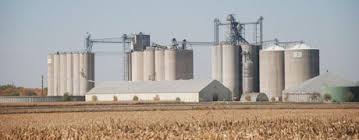
and owned by, farmers, and which I now know was one of several ‘training runs’ we made in the big truck in preparation of me driving several times a day, beginning at age fourteen. Believe me, I watched everything Grandpa did to herd that monster truck thru town. The Co-op was a drive thru so we didn’t have to back in, although that wouldn’t have been a problem for me. Several years later Dad had a new grain storage barn built that would store about 30,000 bushels of grain, plus the combine, trucks, tractors, crop sprayers, tools and the other stuff it took to run a big farm operation. At one time Dad had about 2,000 acres under cultivation, most of it rented. I know he wanted me to take over the farm, to be the third generation to run it, but he told me several times to “do whatever you want, but do it the best you can.”
The 730 was diesel and John Deere tractors had vertical mufflers that were just about head high so no matter which way the wind was blowing, the diesel fumes came right back in your face. To this day I hate the smell of diesel.
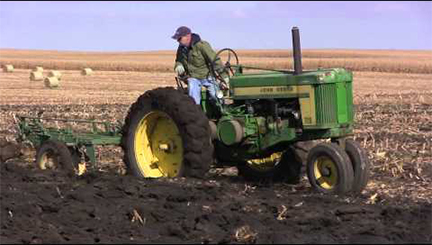
Getting up at dawn, inhaling diesel fumes for hours on end, mind numbing boredom going back and forth in a field on a tractor for days on end, pulling hay bales to the rafters at the top of a hay barn that was probably 120 degrees, soaked to the bones with sweat, and working till midnight on many, many days, I knew I did not want to work that hard. (so I ended up in sales, at which I was a natural having trained by swapping stuff, and ended up working sixteen hour or longer days–, but the only sweat was mental.)
Grandpa’s Barn
Grandpa’s barn started out as a hay barn then Grandpa & Dad converted it to a grain storage barn.  Drawing by Orin Olson
The barn and elevator system were designed by Grandpa. The barn entrance was about ten feet wide, two feet wider than the big truck –
– which I began backing into the barn at fourteen. The grain bins were made from rough cut native oak 2×4’s laid flat and overlapped at the ends.
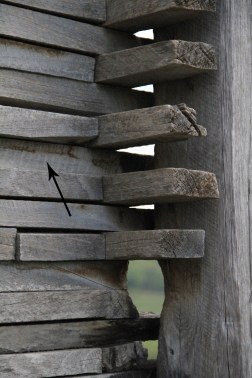
The bins were probably thirty feet high by twelve feet square. There were four 2×12’s, laid flat and stacked atop each other, two bisecting the bin one direction and two perpendicular to those.
You can just see the ends of the cross braces in this photo.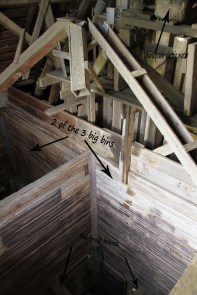
These were to keep the sides of the bins from bulging outward when filled with grain. They were about ten feet from the floor, which means there were about twenty feet from the cross beams to the top of the bins – from which we would jump into the corn, wheat, soybeans, etc. Recalling the bin dimensions, you can see I had a six by six foot square to hit from twenty feet up to avoid hitting one of the cross braces. With a vertical landing, legs together, knees straight, I would be waist deep in the grain. Doesn’t sound like much, but it is very difficult to wriggle out when half buried in the grain! But it was tons of fun! It was not without danger though. When emptying the bins one never got into the grain. The grain emptied thru a one-foot square hole in the floor, and the steady movement of the grain was impossible to climb against. Whoever was in the grain would be sucked under and would suffocate.
Elevator Belt
The truck was backed into the barn until the back of the dump bed was even with the “boot” in the floor. This meant the truck was almost completely in the barn and you had about eight inches of clearance with the truck door open to get out of the cab. It was a tight squeeze, and probably why skinny me, at 5’10” and 140 lbs, was the driver. The boot was a two foot by six foot hole in the floor. The bottom of the boot slanted down to direct the dumped grain to the elevator.  The elevator to get the grain into the bins was a six inch wide belt with a metal scoop riveted about every foot. The scoops probably held five or six cups of grain. The elevator belt was a loop that went from the basement of the barn to the top, so maybe fifty feet long.
At the top of the elevator was a moveable spout  to direct the grain into the seven different bins plus the moveable tube for emptying a bin into the truck. Each bin was numbered and there was a corresponding number of nail punches on the bin guide at the floor of the barn beside the boot.

A rope was pulled to lift the spout then the pole was turned until the pointer lined up with the desired bin number.
Wooden Pegs
The barn was originally constructed, I think in 1895, with wooden pegs and square nails.
The bins were built with ‘modern’ round nails. Since the bin boards were native oak, and like the Pig Palace slats, each board had to be pre-drilled in order to drive the nails without bending them.
The ladder to the top of the elevator was straight up. 
The rungs were about eighteen inches apart which was easy enough to navigate, unless one was
carrying a scoop shovel,  tools or anything else to make repairs. Given the age of the barn it is incredible that it could contain so much volume. I estimate the barn could hold 15,000 bushels of grain at about 60 pounds per bushel or about 900,000 pounds!
Proud farm trashed
The farm was the livelihood for two generations of Shultzes’. Farmers didn’t just go get a new gadget if one broke; they repaired it. They built what they needed. They took care of everything they had because they used everything they had just to live. They took pride in what they did, how they did it, and how they cared for their equipment, buildings and critters. My Dad and Grandpa are probably turning over like mad in their graves with the abhorrent way the Hecks are tending the barns and property they claimed they would care for in the manner in which it had been for over one hundred years. Not only are the barns falling apart
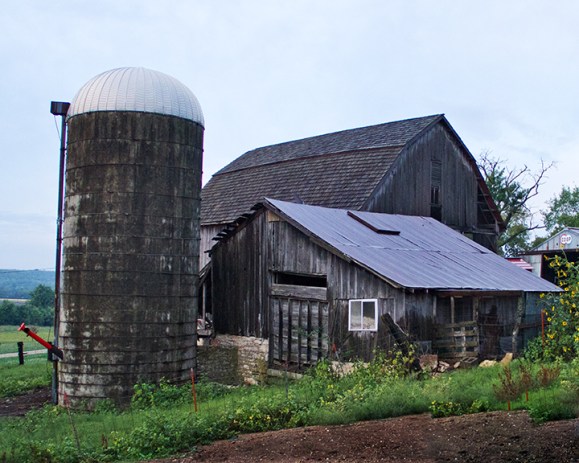

they have lined all of their junk, broken equipment, trash, and crap along the road from the barn to the crick (where I found the water moccasin and where Grandpa found arrowheads, fossils, trilobites and unknown critter teeth). This was done by a man who claims to be an environmentalist and naturalist. When I took these photos I was physically sick and emotionally outraged. Good thing I did not see mr (and I use the term loosely!) heck. In his defense, he does not use the barns for anything but storing junk so I guess it is understandable that he would not maintain them. Still. Got that off my chest!
Arrowheads
Grandpa found several arrowheads and other goodies along the crick.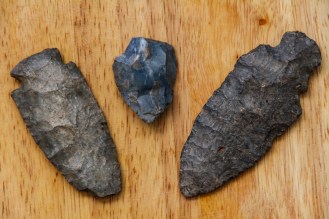

A tooth probably from a wooly mammoth,
some fossils,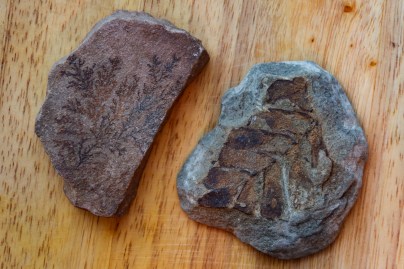
and a Trilobite and fern leaf.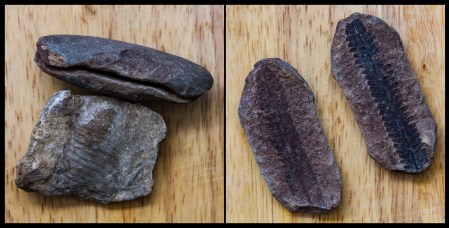
Plowing the big field
One of our tractors was a John Deere model R
It was a monster tractor, at least to a 6 year old. More on this beast in a later installment. Anyway, Grandpa was plowing the big field, aptly named since it was the biggest field we owned at 50 acres. It is the one across the crick where I found the water moccasin. After harvesting wheat, we had to plow the fields to prepare them for planting the next round of crops. One of the difficulties of plowing was when the wheat straw, which was sometimes baled for bedding for the cows and horses, was very heavy or contained lots of dead weeds. (BTW, hay and straw are two different things. “Hay is for horses”, meaning that hay is for food and straw is for bedding.) That was the situation on this day. Grandpa was plowing along when the plow began to plug up. Instead of stopping and clearing out the trash, and because he was using the R which had a wide front end so one front wheel was always in the furrow, which is usually six to eight inches deep, and the tractor would essentially drive itself, he climbed off the tractor onto the plow and was pushing the trash thru the plow with his foot. Two things happened; first his foot got caught, second, the R jumped the furrow and was heading for the crick and a ten to twelve foot drop. Grandpa pulled his pocket knife, which was honed like a razor, out of his overall pockets and he simply cut his boot off so he could get his foot out and get back on the tractor to avoid the crick. After that, there was no getting off of a moving tractor!
A little does a little good
I’m not sure of the particulars but Grandpa was involved in a fertilizer test on wheat. One field was planted with a small amount of fertilizer, and possibly none, and the other was planted with more than the recommended application.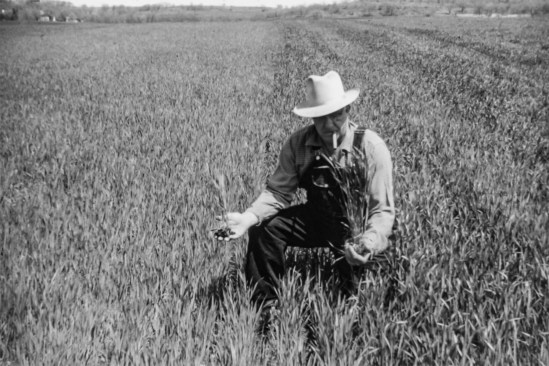
The results are obvious from the photo and the take away is, “A little does a little good and a lot does a lot of good.” Used that a lot. Not sure if it did a lot of good tho.
Grandpa’s Den
Grandpa’s den was a magical place! It was wood paneled with a closet full of guns in one corner, a big rocking chair, a couple of other chairs and his roll top desk. There was a table/chair/high chair combo thing. With the chair folded down it was a seat and attached table for eating or drawing. With the chair folded up on the table it became a high chair. And the blocks. 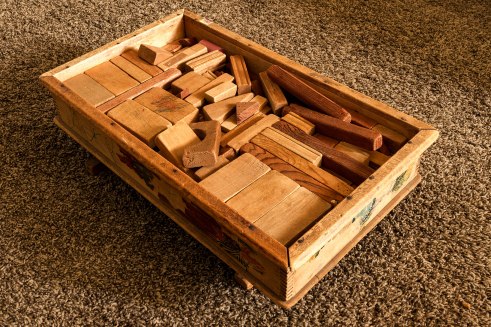 Whenever I would build some fantastical construction it would be left just as it was till the next time I was there. The wooden box used to be completely full. It was difficult to get all of the blocks to fit back in the box with none going past the top edge. Many have been lost over time, or chewed on by dogs.
Grandpa smoked cigars and there was an ash tray standby his roll-top.To this day when I smell cigar smoke it takes me back to grandpa’s den.

Uncle Well, Grandpa’s brother, traveled the world (I have no idea what he did) — from the Orient to the jungles of South America where he got this sword. It is a Legitimus No. 216!

The sword was used on banana plantations to cut the stalks of bananas from the trees. It is said to have been used in the wars which were common between the plantations, and to have killed several men. I did some research since I am not sure if it is a sword or a machete, but the difference is in the intention. This is what I found: The blade is intended for use as a machete first (banana harvesting), sword second (plantation wars), so it would serve either purpose. The markings would suggest that it was intended for a Latin American market.
My research corroborates Grandpa’s story, albeit maybe not the killing part, so whether that was true or not, we will never know.
But Grandpa would never lie to me.
He also had a collection of wooden puzzles which were also sent to him by Uncle Well.
Grandpa’s Puzzles
Notice there are three puzzles in pieces…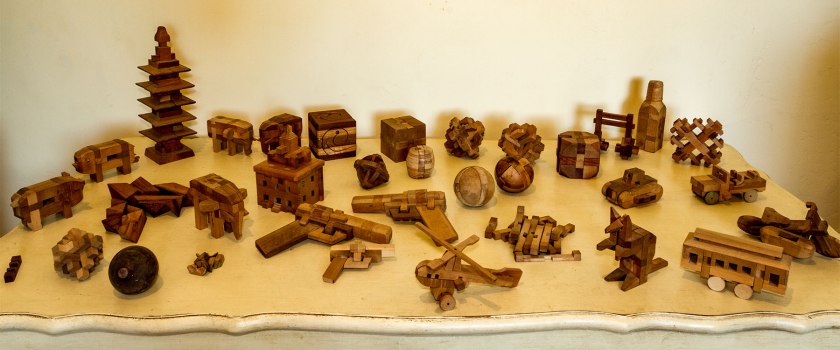
The puzzles were kept in his den in an antique barrister book case.
There are thirty-three puzzles. I would get one out at a time, as per Grandpa’s stern instructions, take it apart then put it back.
A little side note here on “stern instructions.” When an adult, strangers excepted – unless it was an emergency, told you to do something, you DID IT. Police officers? Like adult relatives, the proper response was “Yes Sir/Yes Ma’am!” There was the unspoken threat of getting a whoopin’ with the belt (never happened) but of utmost importance was trust and respect. They trusted us to do the right thing and we respected them and did not want to disappoint them. Unfortunately there were some times when I could see the hurt in Dad’s eyes and I knew that I had sorely disappointed him. That hurt more than a belt ever could.
back to the puzzles…On many occasions I was not able to reassemble the chosen puzzle and would leave the pieces in a pile on Grandpa’s roll-top. The next time I was there the previously disassembled pile of puzzle pieces was correctly re-assembled and it was sitting on top of the roll-top. There are no instructions for the reassembly of these puzzles.
Grandpa’s Puzzles become Guy’s Puzzles
I became the re-assembler of piles of puzzle pieces when we lived on Donee Diego Dr. I had the puzzles on shelves in my office, which was a room converted in the garage. Unlike Grandpa, several of them were off limits to my kids, for two reasons: no reassembly instructions, and no one is as smart as Grandpa was. Nevertheless, I would frequently find one in pieces on the floor. I would dutifully put it back together and put it on the top of my roll-top desk (not Grandpa’s desk). That always sent me back to Grandpa’s den. Somehow I now have three puzzles that are in pieces. Two should be relatively easy to reassemble, the other, however, is gonna be trouble. I have no recollection of what it even looks like!
Puzzle Pieces Reassembled!
These are the three puzzles that were in pieces.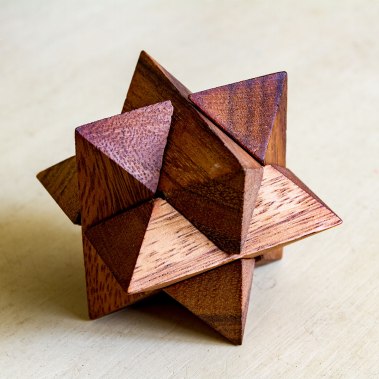

I have to admit, after some cogitating, and some googling, I remembered what it looked like and was able to find a basic drawing of two steps of assembly. It is a Miyake Puzzle.
From this 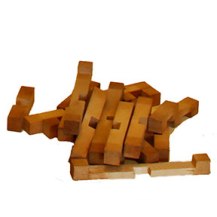
to this
These are puzzles that were added to my collection by my kids.
Not only could Grandpa turn a hay barn into a granary and re-assemble piles of puzzle pieces, he was very smart – keep reading…
County Commissioner
Grandpa was the County Commissioner for Jefferson County for ten years. Here is an article about his efforts. 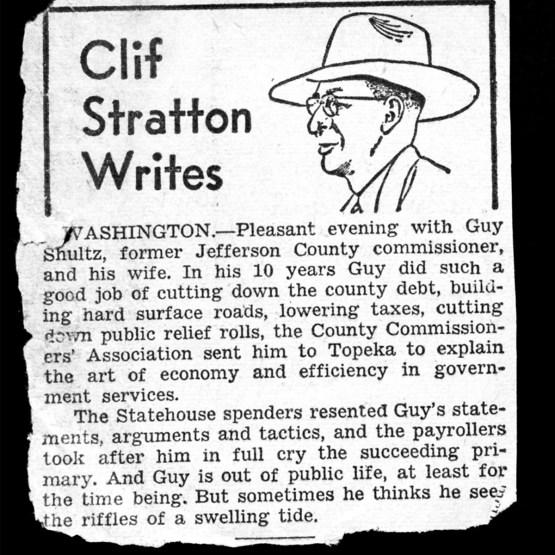
Canning corn
 When the sweet corn was ready to pick everyone was involved including Mom, Grandma, Aunt Caroline and Michele Ann, who would all come to help with the canning. We planted sweet corn for canning and corn on the cob with a four row corn planter just like we did for the corn we sold. Canning corn was serious business! When the tassels began to turn dark we would walk thru the acre or so we planted for canning/eating testing the kernels with a thumbnail, being careful to replace the husks after testing. You could tell if the corn was too young because the kernels would not be full. If they were just right when you jabbed a kernel with your finger nail, white juice would squirt out. If too old, no squirt. We usually loaded 10-20 gunny sacks with corn.
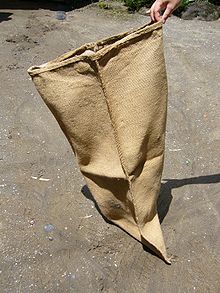
A gunny sack is about the size of a thirty gallon trash bag. Then we had to husk and clean the silks off. The ladies took over at that point and cooked the corn for canning. I would try to weasel in when the corn was done to ‘help’ cut the corn off of the cob. I probably ate as much as I put in the canning tub. Canning is more than I want to describe here. Read a cookbook or google it if you want. Once the mason jars were sealed and cooled they were distributed between those helping and the ones kept would go on the canning storage shelves. Inside the basement door Grandpa had built shelves just tall enough for the jars. There were probably sixteen shelves by four feet long.
Our shelves did not look like this. We canned corn. Well, probably some “rabbit food” (any green vegetable) too but nothing like this;

Next time: Around Lawrence.
 sunnyside53.com