
Grandma’s Quilting
While this is primarily about Grandpa’s guns, it seems fitting to spend a bit of time with Grandma first. After high school she attended KU for one year and was on the basketball team. In all of Tracey’s genealogy work nothing could be found about how Grandma and Grandpa met.


My Grandpa was a formidable man and had a huge influence on me. But even so, Grandma held her own and deserves recognition. This is the throne she ruled from.

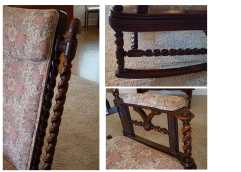
She kept Grandpa in line, she always set the table for breakfast before going to bed at night, and she organized the canning, which involved 3-4 women, 2-3 men, and a boy (said boy would help with the pickin’ and shuckin’ then avail himself to helping in the kitchen cutting the corn off the cobs and eating as much as he could get away with), mason jars, pots, and all assorted canning paraphernalia. When I spent the night with them, I would sneak — although sneaking was virtually impossible in that squeaky old house — into Grandpa’s bedroom to spy on them thru the furnace vents while they played canasta – Grandma usually won. I have been told that Grandma could be quite cantankerous, although I never saw that side of her since I was the favorite.
She also made incredible quilts – all hand stitched. In 1942 she joined a Lawrence women’s club, United Home Service Club, to support servicemen from Douglas County. Each box they prepared contained candy, a white handkerchief, shaving lotion, a prayer, and the name of the club. (remember all of the boxes Tracey made and shipped to servicemen from the Sunset house?) Only three of Grandma’s boxes came back unclaimed. In the later years they met each Tuesday in the basement of the Lawrence Community Building to quilt all day long. They sold the quilts to fund candy, fruit, cookies, cigarettes, gum, writing paper, envelopes, and cards for veterans at the VA Hospital in Leavenworth. When the club was disbanded in 1986, Grandma was the president. The $200 they had left in the treasury was donated to the Salvation Army.
I have her quilt frame. It’s made of two eight-sided wooden rollers about eight feet long on a stand at each end. Similar to this;
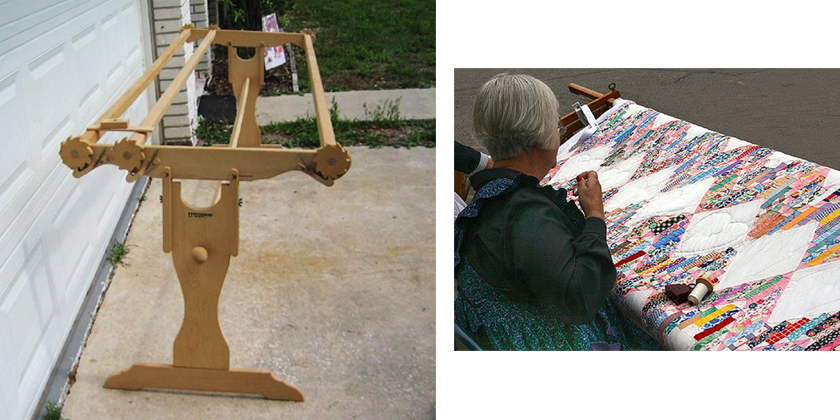
(That’s not Grandma, at least not my Grandma) The material and batting is rolled up on one roller then stretched across, about twenty-four inches, to the other roller and the quilting is done between the rollers. When that area is done, end to end, it is rolled to the other side and a new blank canvas is revealed. Eventually, she developed a nerve problem in her stitching hand and finally could not hold a needle between her thumb and index finger. She was, however, able to complete the quilt she had started and it is probably the most beautiful quilt I have ever seen (uhmmm, maybe second to Tracey’s?). It is known as the Butterfly Quilt and was given to Sherri.


Now for Grandpa’s Guns
One of my favorite things to do at Grandpa’s was to lose myself in his den. Inside the door to the right was the rolltop desk with the “secret” door in the side. Because it was so secret, there were no secrets inside. There was a cigar-stand ashtray
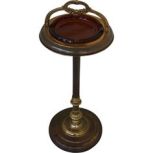
that was usually by a big craftsman-style easy chair

but occasionally it would be by his rolltop. The heavy, stale, pungent smell of cigars will send me right back to that room.
Directly opposite the door was the bookcase with the wooden puzzles I told about in my last post. In the far right corner was the gun closet. The closet had a bottom cupboard about three feet tall filled with the handguns, boxes and boxes of ammo, civil war paraphernalia, matchbook collection, and the wooden blocks (when they weren’t under construction on the den floor). Above the cupboard was the tall closet that held all of the long guns. We didn’t need safes or locks then because gun safety was taught at an early age, not to mention the threat of severe physical harm — a belt was frequently mentioned — was sufficient to install a deep respect for guns.
As a side note here, I do not recall ever having first-hand experience with a belt but I did receive a whoopin’ or two. Dad would ask me if I wanted to go get a switch from the willow tree (one always had to cut one’s own switch – which I never had to do), and that’s all it took. Dad always said it hurt him more than me but I didn’t believe him for a second! I now know what he meant.
After Grandpa died, the guns all stayed where they were until Grandma moved to Lawrence. Then, when Uncle Herb, Grandpa’s brother, died, Dad bought his farm, which was the original homesite.

The house was originally further back from the road up on the hill in the trees and was later moved to the current location. It was raised and put on giant beams just like they move houses today except they used horses instead of trucks to pull it.
Uncle Herb had married late in life, and his wife Caroline (caro-line, not carolin, and she was AUNT Caroline) was, as I recall six-foot-one. She had Uncle Herb remodel the kitchen and make the counters 40” tall (a typical kitchen counter is 36”) so she didn’t have to stoop over. That was fine until Dad bought the place and had to de-model the kitchen for Mom who was five-foot-two. So anyway, Dad moved all of Grandpa’s guns, which were now actually my guns as I inherited all of them, to his ‘new’ den at Uncle Herb’s old place. He had native oak rough cut into 2×6’s then cut 1 ½” dowels about eight inches long. He drilled holes at a slight angle into the oak boards for the dowels. He then cut strips of leather straps about a foot long and cut a slit into each end to make a loop on each end. One loop went around a dowel and the other loop went around a rifle barrel or stock. So it took two dowels and two strips to hang a rifle. He installed the 2×6’s at the top of the wall, where crown molding would normally be, all around his den. This is where Grandpa’s guns, my guns, hung until Dad died.
Beth and I flew back home for Dad’s funeral and to get my guns and a bunch of other farm stuff. I have one of the blank cartridges fired at the Marine seven gun salute at his funeral.
A few days later I rented a small U-Haul truck and Beth and I took off for California. We were coming into Las Vegas one evening just before dark. I was going to take the next exit for a hotel I had seen signs for when one of Las Vegas’ finest lit up behind me. I pulled over not knowing what I had done wrong and praying they would not look in the back of the truck where the guns were. It was not so much that there were guns but one was highly illegal! Turns out one of the rental truck tail lights was out and they were just letting me know – for safety. I explained I was planning on stopping at the hotel that was now in sight and told them I would get it fixed first thing in the morning before we left. They were fine with that and went back to their car. Heavy sigh of relief! I did not know how I was going to explain to Tracey that Beth was with children’s services and I was in jail in Vegas!
Years later I took the guns with us to Virginia then hauled them back to California again.
Handguns
- Colt 1851 Navy

This Colt Navy is patent #2099 , and I find it interesting that the serial # is 182099! It was manufactured in 1865. All parts have matching serial numbers. It is a civilian model, not military issue. I have shot both Colts, and it is awesome! Read the last paragraph for a great description of firing one of these beauts.
The .36 caliber Colt 1851 Navy cap and ball (percussion) is considered the most famous handgun ever made. It is a 5-shot revolver with a hexagonal 7.5″ barrel that was wielded by historical figures like Wild Bill Hickok, Doc Holliday, Robert E. Lee, and Rooster Cogburn. Wild Bill dropped a man from 75 yards in a shootout in Springfield, MO, in 1865. It saw service under the Union Flag, the Confederate Flag, and the Black Flag of Quantrill’s Raiders.
Its smoothness of operation, terrific balance, and natural aiming quality were never equaled in its time. Even after cartridge revolvers came along, many gunslingers continued to prefer the Colt Model 1851. It was the most popular firearm of its day among military men, peace officers, and civilians.
The gun would see worldwide service and would be the standard issue handgun of the Confederacy in the Civil War. Despite that it was meant for the Navy, Army personnel purchased most of them.
“When you pull back on the hammer, there are two very distinct clicks as it goes from half to full-cock. Located at the tip of the now-cocked hammer, the rear sight aligns perfectly with the front bead sight. When you pull the trigger, the hammer drops on the percussion cap. After that, there is a noticeable but very brief delay as the powder ignites. The explosion occurs and a cloud of white smoke emits from the cylinder and the breach. This is shooting in its purest form. The sounds, sights, and smells are a trip back in time to gunfights on distant smoke-filled battlefields and shootouts in barrooms. You get one shot—maybe two—and at six, you are done! What a gun. What a time!” Author unknown.
- Colt 1860 Army


This Colt Army was patented September 10, 1855, manufactured in 1863, and is serial # 111677. All parts have matching serial numbers. It is a civilian model, not military issue. It is a six shot, .44 caliber handgun with an eight inch barrel and notches to accommodate a matching shoulder stock. I searched gun shows for years trying unsuccessfully to find a shoulder stock.
Along with these two Colts, there was a US belt buckle , black powder flask, black powder horn, cartridge box, and a percussion cap box. With all of these accessories, it is difficult to imagine one or both of these Colts not seeing service in the Civil War, however, based on the serial numbers, both of these Colt handguns were civilian models and were not ‘officially’ used in the Civil War.
Since the Army and Navy Colts each had interchangeable parts (not with each other since they are different calibers), troops would sit around a table cleaning their guns and just grab a part to re-assemble their guns. Consequently, it is fairly rare to find 2 specimens, each with matching numbers.
John Wilkes Booth, assassin of President Lincoln, was killed with the 1860 Army pistol after a 12-day manhunt in April 1865.
- .22 Colt Woodsman Automatic Long Rifle
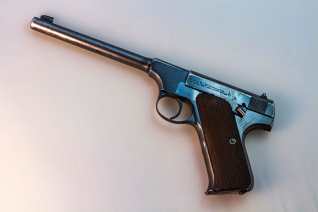
This Colt Woodsman was manufactured in 1925 and is serial # 43699. It has a 6 5/8” barrel. I have shot this beauty many, many times! While it is labeled as “Automatic,” it is in reference to automatic loading, not continuous firing when holding the trigger down. You must squeeze the trigger each time you want to shoot. I researched this one to be sure it was safe to shoot. Since it was manufactured in 1925, NO HIGH VELOCITY AMMO should be used. Although it is very well made, it shouldn’t fail if you shot some high velocity rounds, but why would you? First concern is safety and second, there is no need to abuse an old beauty like this one. It is safe to use with standard or target ammo.
- .35 Smith and Wesson Auto CTG
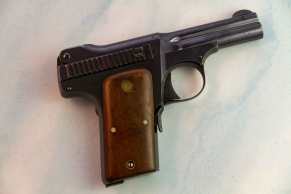
S&W serial # 4512 with two clips. This gun was owned by Uncle Ferd from Valley Falls.
He was a horse trader who later became, appropriately, a used car salesman. Aunt Ethel was the telephone operator mentioned in #3. After Uncle Ferd died, Dad & I took it home, took it apart, and with parts spread out on the kitchen table, Mom commented, “Bet you can’t put it back together without extra parts.” We did and no extra parts were left over. Dad & I went out to shoot the newly stripped and cleaned gun. Threw some beer cans out in the field about 25 feet or so. I took careful aim and squeeeezed the trigger. The gun gave a wimpy ‘pop’. We literally watched the bullet leave the barrel and go about 5 feet. So, we went to town to get some ammo. The owners of both gun shops we went to wanted to buy the gun on the spot. The .35 caliber ammo had not been made in years and if found, probably would not be any better than what we had.
I recently acquired a ‘new’ Colt’.
- .22 single shot

One grip gone – very rusty. SN 34024. As far as I know, this handgun has always been non-functional. As such, it was one I was allowed to play with till about age 10 when I could play with the ‘real’ ones
- .626 cap and ball pistol (19 gauge – consider the size of a 12-gauge shotgun)
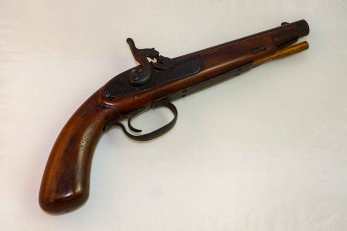
This is another one I was allowed to play with. The name “Joseph” is engraved under the hammer. There is no serial #. It is 5/8” diameter – considering the size of a .44 caliber, this thing is a monster! We never fired it because we had no mould for balls and the hammer would not stay cocked, which is probably a good thing!
- 7mm (.284) French Pinfire
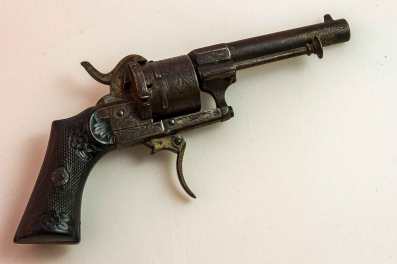
Folding trigger – 6-shot revolver – SN 8774 This is manufactured in France, rather than Belgium, as evidenced by the stamp, Eugène Lefaucheux on the barrel. This intricately engraved handgun was also widely used in the Civil War, although ammo was difficult to come by.
- .32 Nero
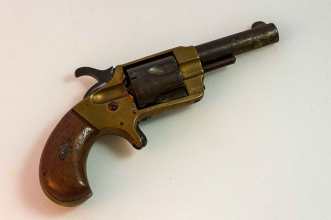
This 5-round, single shot, rim fire revolver with a spur trigger (no trigger guard) has a brass body that was originally nickel-plated (polished nickel looks like chrome) but it was in bad condition, so Dad’s hired man, Chuck, who was really into guns, used the brush on the shop grinding wheel to brush off the nickel coating. It also had huge, clunky grips. Chuck removed these and carved the grips seen here, which are the original style. This type of handgun was a cheap alternative to Colt revolvers and was called a suicide special because they were prone to explode in the user’s hand because of the low-grade material.
Bowie Knife
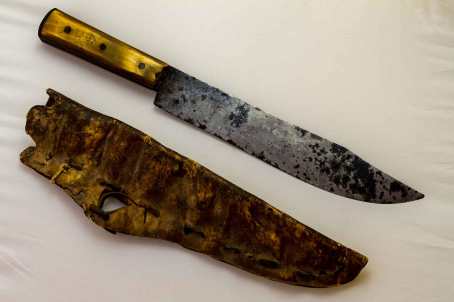
Don’t know the history of this but it is one badass knife! The blade is about twelve inches long and the sheath is leather – very, very dry leather.
Long Guns
- Springfield Trapdoor Carbine – U.S. Model 1884 – SN 381449 – 499 were made in 1875, the date of manufacture of this SN.
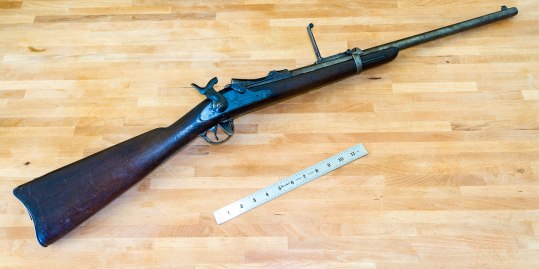

This carbine was given to me by Mr. Hotchkiss when he moved from Donee Diego Dr. The street was named after his wife, Donee. I had commented on his life-size cutout of John Wayne, which started a conversation about guns, and I mentioned that I had a Springfield Trapdoor Rifle. He thought I should have the carbine to go with it. He stopped on his way out the last day he was there and gave it to me. I was flabbergasted! Remember the VW Thing he had?
A .45-70 from the so-called Custer Gun period (prior to June 1876 with serial numbers below 43,700) is easily worth several thousand dollars. They are known as “Custer Guns,” as there is a possibility they saw action at Little Big Horn. This is definitely not a “Custer Gun” but is a classic Springfield Trapdoor Carbine. Carbines were fitted with a stock-mounted bar and saddle ring to be hooked to a leather sling worn diagonally across a trooper’s body, thus curtailing accidental loss from the saddle.
General George Armstrong Custer’s battalion was armed with the carbine version of the Springfield Model 18 at the Battle of the Little Big Horn, also known as the Battle of the Greasy Grass, on June, 25 & 26, 1876. Custer led the unprepared 7th Cavalry based on poor intelligence, bad tactics, and hubris against the Native Americans who were better armed with the superior Henry, Spencer and Winchester repeating rifles. These weapons poured fire into the 7th Cavalry ranks, and the belief that Custer lost at Little Big Horn because of malfunctioning hardware has been largely debunked. The single-shot Springfield Carbines were simply outmatched.
- Springfield Trapdoor Rifle – U.S, Model 1873 SN 251641
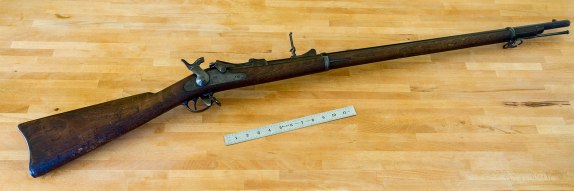
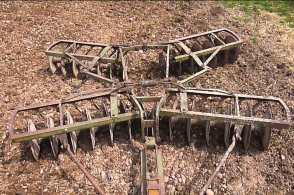
This is also a .45-70. I have fired this sucker and it kicks like a mot…, well, it kicks. This is the rifle that Chuck, the hired man, and I would use to shoot a disk that was about ¼ mile away in a field.With the rifle held at about a 45 degree angle, pull the trigger, pick yourself up off the ground, then listen carefully and you could hear the ping of the bullet hitting the disk. It was awesome! Read on…
“The Model 1873 was a very powerful rifle and the recoil proved too robust for mounted troops as it tended to unhorse the soldier.” I love that description and can just visualize it! Unless you stand with feet apart, lean forward, back leg with foot perpendicular to your body and front foot pointing the direction you are shooting, you will be unhorsed (or knocked on your ass)!
Chuck was a gun nut and was always trading guns. At one point he had acquired a couple of .45 magnum revolvers that we used to shoot five-gallon cans filled with water. They would explode about six feet into the air with the lid going another ten feet higher and water would spray about ten feet in every direction.They were also fun to use to cut down five-inch diameter trees – with one shot.
- Enders Special Service Double Barrel, Side by Side, 410 Shotgun SN 13687

This is the renowned 410 shotgun from the “410 Incident” in installment 2 in which Larry and I burned down a shack above his house. This is a beautiful shotgun. Belying its small bore it has a significant kick, possibly because it does not have a shoulder pad.
- Unknown maker, no SN

Trapdoor style, breech loader. Got nuthin’ on this one. It has always been in this condition.
- Unknown maker, no SN

Double barrel, hammer style, side-by-side shotgun
Got nuthin’ on this one either! I am sure the black electricians tape will enhance the value. I think the stock is made from a 2×6 board.
- Winchester Model 74 .22LR $250 SN 266271A – manufactured in 1950
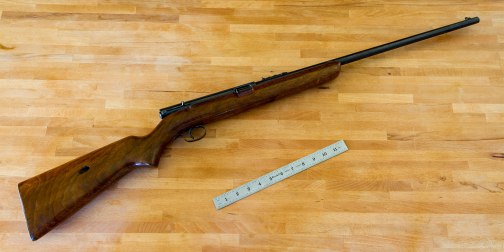
This was a go-to rifle for shooting squirrels, rabbits, and sparrows, plus lots and lots of cans. This is a semi-automatic – you gotta pull the trigger each time you want to fire, but it is automatic loading.
- Gallager Carbine SN 6196 .56-52
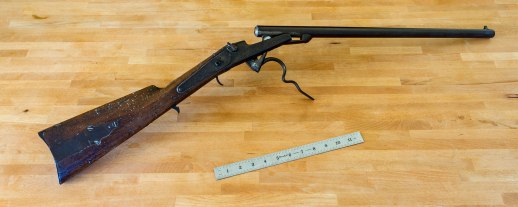
Remember the TV show, The Rifleman? No, too bad. It was a great show about this guy, the rifleman, with a modified Winchester .30-30 that he could shoot like an automatic. I used this rifle to play the Rifleman. It was the only one with a lever.
This is a Civil War period rifle that was chambered for the Spencer 56-52 cartridge. It has a cartridge extractor and a firing pin design instead of a percussion nipple. Many of these carbines were bought by France and used in the Franco-Prussian War. It is a single shot design where the barrel moves forward to load. Less than 25,000 Gallagher Carbines of all designs were ever produced. It frequently would jam with the expansion of the brass cartridge, which prevented extraction. The hammer on this one is missing. With the hammer could be worth $3,000.
- Savage Sporter Model 23D SN 222615
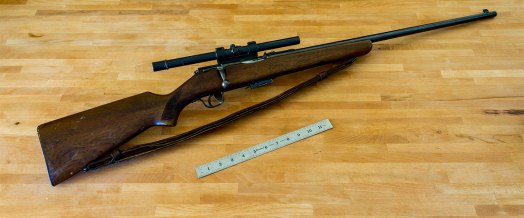
This one’s a Pre WWII Savage Sporter .22 Hornet bolt action with a Weaver G6 scope and has the original leather sling. I used this rifle for hunting rabbits and squirrels and for shooting sparrows off the barn power lines (sparrows are a trash bird and can ruin a bin of grain). One day, I was going from the red house to Grandpa’s place to help with shipping a load of hogs to market. It was just after sunup and there had been a hard frost. The window on my Cougar was completely frosted, and I was late. I scraped a hole I could see thru, then jumped in and headed out with the defroster blasting cold air. It didn’t heat up appreciably in the mile to Grandpa’s. As I was heading to the Pig Palace, I saw a coyote running across the field. I stop, grab the Savage from the back seat, lean across the roof, draw a bead on the coyote, and squeeze a shot. I must have bumped the scope when I put it in the backseat in my hurry to leave. I hit the coyote in the rear end, which stopped him in his tracks but did not kill him. So I had to get closer to dispatch him, and the entire time he was looking me directly in the eye. It was hard to shoot him with him staring at me like that but I had no choice at that point. It was the last time I shot that rifle and the last critter I killed. So to answer the person on Facebook, who does not know me, who ranted that I, as a gun owner, “was part of the problem”, I submit that you as a narrow minded “Chicken Little,” are the REAL problem. So up yours!
- Ferd Percussion (cap and ball) Musket SN 860
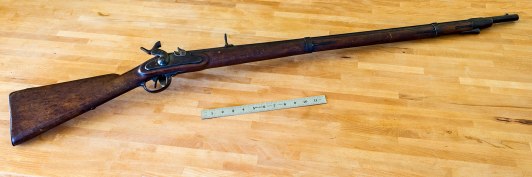
This was a fun one to play with. It is looong and not too heavy. It cocks and has the ram rod. I was a regular Davey Crocket and of course I had to wear my official Davey Crocket coon skin cap when toting this in the hills killin’ bad guys. To date, I have not been able to find out anything about this musket.
- Kentucky style flintlock converted to percussion (cap and ball) No SN

This RW Booth musket weighs over thirteen pounds. It has two birds and a bird dog engraved behind the hammer. There are two triggers, called a double-set trigger. You pull the rearmost trigger to set the front trigger which has a very light pull. Given the double-set trigger, length of the rifle at five feet, and the weight, I think this was primarily a target rifle. It would have had a forked monopod to rest the barrel on to steady it for firing. It was probably originally a “Kentucky” style Flintlock Long Rifle that has been converted to percussion. The barrel is larger in diameter than a quarter. That may not sound like much but make that quarter five feet long and made of iron and you get the picture.
- Cap and Ball Musket no SN

Hey, it’s a firearm! Another from my Grandfather’s collection, but I never played with this one only because there were so many others that were way cooler.
- Stevens Model 15A Savage Arms Co .22 No SN

This was my first rifle, a single shot .22 short, long or long rifle. It was a Christmas present I think when I was 12. I still have the box it was shipped in to Ernst & Son Hardware in Lawrence from Gem State Sporting Goods in Mountain Home, Idaho. I have no idea how Dad located this without google!
- Japanese Arisaka Type 38 5 x 50mm SN
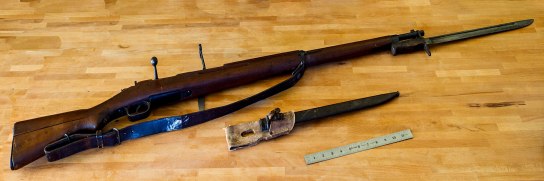
My dad “took this off a dead Jap” during WWII. Please do not chastise me for the language, which is what he used at the time! He got permission to bring it home after he was wounded on Saipan. He was in a foxhole with two buddies when a hand grenade was tossed into the foxhole. His two buddies were killed and essentially shielded Dad who took shrapnel in three places. It is a Mauser-style bolt action with a 5-round staggered box (magazine). The sling and bayonet are original.
- The Rat Killer

Ok, it used to be a long gun! This is a 12-gauge shotgun. The barn had a rock foundation, and rats would get in the cracks between the rocks. I would take this monster and creep down the stairs to the barn basement. It was fairly easy to sneak up on the rats as they were not afraid of anything. I’d point it in the general direction and hold on like crazy. The noise while halfway down the stairs in the basement was like a cannon blast. My ears would ring for hours. Damn, it was fun!
This is the highly illegal one I mentioned in the U-Haul above. It has since been disposed of. I have mentioned earlier that Dad’s best friend, Fred, was the Sheriff of Douglas County. He and his son Mike, my other best friend, were with us at Grandpa’s and we were talking about guns. Dad brings this out and Fred says, “Shit, Ren! You gotta get rid of that thing! I’ll pretend I didn’t see it.” Then of course, we all had to shoot it. Hold it straight out in front of you, pull the trigger, shoulder gets dislocated, and arm now is pointing straight up. Not to mention deafening. Fun stuff!
- .30-06 and 12-gauge Winchester Pump Shotgun

We also had a .30-06 and a Winchester pump shotgun. These were both beautiful guns and I have no idea what became of them.
- The 7mm Mauser with thumb-hole stock
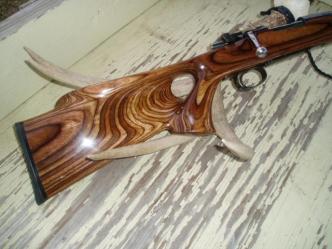
I would go to gun shows with Chuck and became a decent gun trader, given my first-grade training at swapping. I acquired a 7mm Mauser. It was a run of the mill rifle in great condition. Then I found a stock blank, which is generally a hunk of wood in the general shape of a rifle stock. It also happened to be crotch black walnut, which means it was cut from a black walnut tree at the area where a branch grew from the main trunk. This makes incredibly beautiful wood when finished and polished. There is grain running both lengthwise and crosswise. I spent hours and hours cutting the groove for the barrel and space for the trigger assembly. Then, when the rifle finally fit, I started carving the thumb hole and grip for my hand. The finished piece was a work of art. I loaned it to a relative who loaned it to one of his relatives, and I lost track of it – primarily because I had left for California and the Navy.
- Saving the BEST for last, the Spencer Carbine
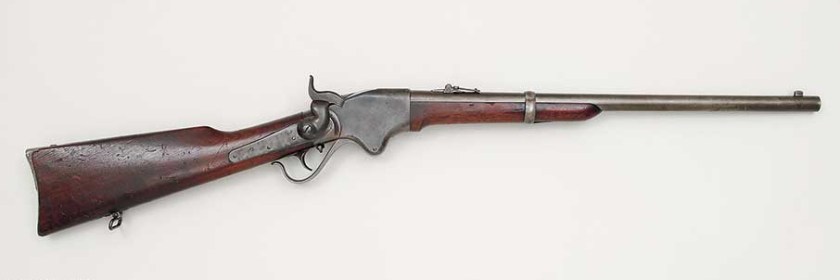
The absolute premier rifle in the collection was the Spencer Carbine. This rifle now belongs to Lee who, when Dad died, said he would like to have one of his Grandpa’s guns. This is the “musket” he chose. Wise kid!!
“Actual Civil War-issue specimens are serial numbered from 11,000 to 61,000 (since Lee has this rifle, I do not know the serial #). More rugged than the Henry, the Spencer was more suitable for cavalry and had more firepower than any standard U.S. service weapon until adoption of the 1903 Springfield. The Spencer is a superb collector’s item and should be an excellent investment.

“The Spencer carbine is chambered for a .56-56.It replaced the muzzle loading rifled muskets of the time. It was a key factor in the battle of Gettysburg by Custer over Stuart and the pursuit of Lee until he escaped over the Potomac.
“Troops armed with Henrys and Spencers would often fire a volley then wait. The enemy, thinking they were reloading, would attack across the open, only to be greeted by a hail of lead from the muzzles of the repeaters.
“General Porter Alexander, CSA Artillery, commented that if the Union would have adopted repeaters in large numbers, the war would have ended within a year or two at the most. What the military would not accept was the fact that the Henry and Spencer made single shot weapons obsolete for regular army use. Their failure to adopt a repeating rifle sooner cost many soldiers their lives.
“It was replaced by the trap-door Springfield 45-70. The 1873 Trapdoor Springfield, although an excellent and durable weapon, was outdated when it was introduced. Even though it had greater range with its .45-70 caliber, the common soldier had very little target practice and was unable to hit targets consistently at ranges beyond 150 to 200 yards, the effective range of the repeaters. So the trade-off of rapid fire for greater range was a poor trade.” Author unknown.
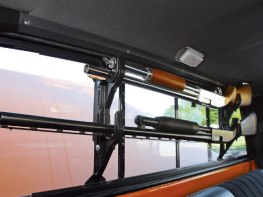
Then of course, there was the ever-present easy-rider rifle rack in the pickup. It always had at least one rifle and quite often two. We would go to town (Lawrence) with rifle(s) in the rack, go to the CO-OP, hardware store, and those places farmers tended to patronize, and leave the truck unlocked. Guns or no, I do not remember ever locking the cars or trucks when we went somewhere. Different times they were!
I reckon ya’ll are full to the gills with gun talk so I will wrap this up with one last short story about Grandpa stuff
The Grandfather Clock
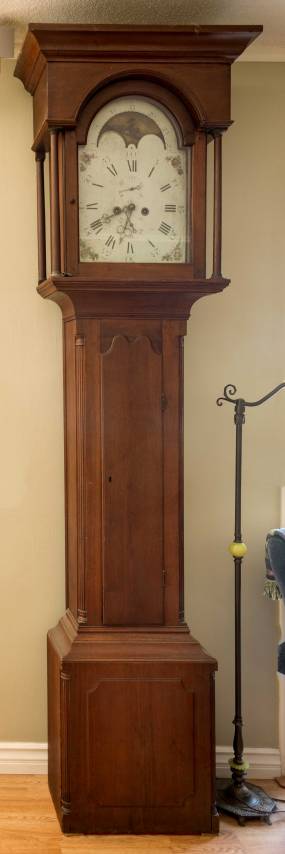
The story goes that this clock came to Kansas in the back of a covered wagon — sounds reasonable to me. It is eight feet tall and has hands for the hour, minute, second, AND days of the month! Most tall-case, long-case, or floor clocks, as they were first known, only have hour and minute hands.
In addition, it has the four seasons! It is a dual-weight, eight-day clock, only requiring winding once a week, and has a pendulum-driven timepiece that was the world’s most accurate timekeeping technology of their day.
The origin of the term “grandfather clock”: The Oxford English Dictionary states that the 1876 song My Grandfather’s Clock is responsible for the common name “grandfather clock” being applied to the longcase clock. This all occurred in The George Hotel in Yorkshire, where an American songwriter by the name of Henry Clay Work discovered a long grandfather clock. When he asked about the clock, he was informed that it had two owners. After the first owner died the clock became inaccurate and when the second owner died, the clock stopped working altogether. The story inspired Henry to create the infamous song. Wikipedia
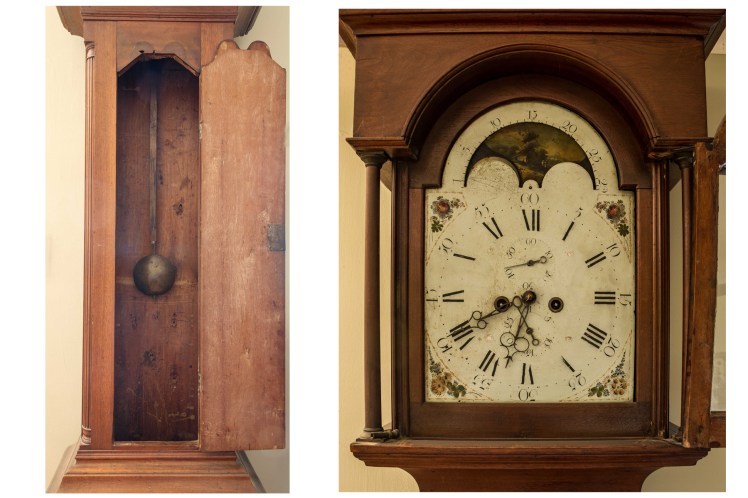


This clock lived in the dining/living/quilting/canasta room next to Grandma’s rocking chair. When Dad moved it to Uncle Herb’s place, it stopped working. I moved it to California in the U-Haul and it sat silent in the Sunset house. One day John DeBlanc saw it and asked if he could take it to his clockmaker to see if he could get it running again. John had hundreds of clocks. His clockmaker had it for several months, then one day John showed up with it – and it worked. Then the time changed with daylight savings so I figured I’d re-set the clock. Wrong. Much to my chagrin, it has not worked since.
Next I’ll talk about horses and building stuff.
 sunnyside53.com